
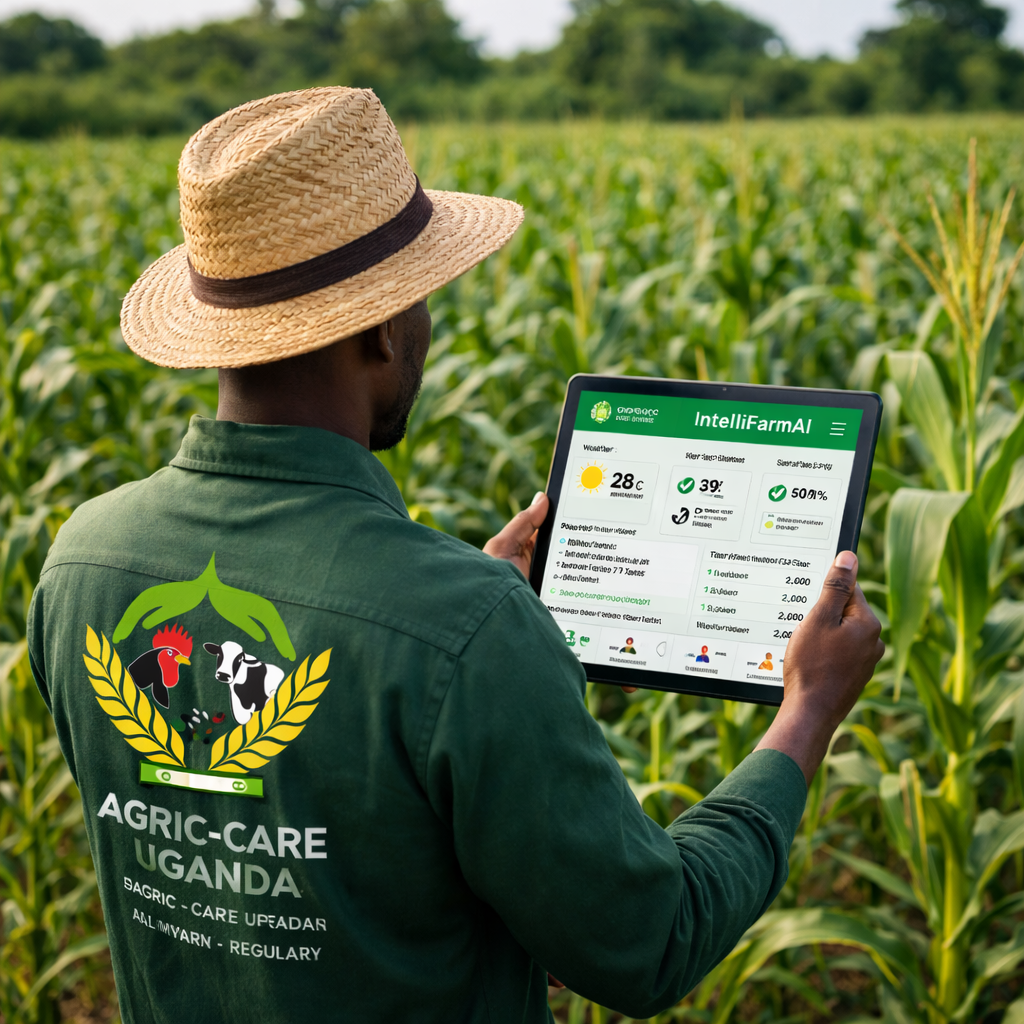
IntelliFarmAI: Ugandan-Built AI for Smarter, Safer, More Profitable Farming.
In a small farming community in Napak District, Karamoja, a farmer points his smartphone camera at a maize leaf showing early signs of pest damage. Within seconds, an app identifies the pest, recommends a MAAIF-approved treatment, and flags-automatically-that one of the chemicals he was about to buy is banned in the European Union due to its carcinogenic properties. He chooses a safer alternative instead.
This is IntelliFarmAI in action-a Ugandan-built, AI-powered farmer decision support system that is quietly addressing some of the most persistent challenges in our agricultural sector: poor soil information, weak extension coverage, fertilizer use with no yield benefit, unsafe agrochemical use, and the export rejections that cost our economy dearly every year.
The Scale of the Problem
Agriculture remains the backbone of Uganda's economy, employing roughly 70% of the workforce and contributing approximately 24% of GDP. Yet the gap between what our farmers harvest and what they could harvest remains enormous. Uganda's average maize yield sits at around 2.5 tonnes per hectare, against an attainable yield of 5 to 6 tonnes under improved management-a gap of more than 50%.
Much of this gap comes down to information, not effort. Studies by CIAT and IFDC estimate that over 80% of Uganda's agricultural land suffers from nutrient depletion, yet fewer than 5% of smallholder farmers have ever conducted a soil test. Without this information, farmers apply generic fertilizer recommendations that waste an estimated 20 to 30% of input spending with no corresponding yield benefit. At the same time, Uganda's extension worker-to-farmer ratio stands at roughly 1 to 1,800-far below the 1 to 400-800 recommended by the FAO - leaving the vast majority of farmers without timely, localized guidance.
Perhaps most urgently for our national economy: Uganda loses approximately USD 60 million annually in export earnings due to international rejections of agricultural produce caused by prohibited pesticide residue violations, with the cumulative cost of standards-related interceptions reaching upwards of USD 100 million annually across all affected export markets. Much of this stems not from negligence, but from a simple lack of access to information about which agrochemicals are approved, restricted, or banned-and why.
A Locally Built Solution, Grounded in Global Science
IntelliFarmAI was developed by Agric-Care Uganda Limited, a Kampala-based agribusiness company, working closely with smallholder farmers across Uganda's agro-ecological zones. The app is live on the Google Play Store and currently serves farmers across all 10 of Uganda's agro-ecological zones, with deep roots in our cooperative network across Karamoja.
What makes IntelliFarmAI distinctive is the depth of science behind it. The platform integrates institutional data from MAAIF, NARO, FAO, IITA, USDA, and the Soil Science Society of America, alongside peer-reviewed tropical crop literature from international research institutions including Michigan State University, UC Davis, and Arizona State University. Its soil intelligence layer combines satellite soil mapping from iSDAsoil—providing 30-metre resolution data across the continent - with a proprietary machine learning model trained on over 500 local Ugandan soil samples, ensuring recommendations are both scalable and locally accurate. For precision, the app also offers an input interface for lab test soil data, enabling higher-accuracy predictions for farmers who have conducted formal soil analysis.
From this foundation, the app delivers five practical services to farmers: crop recommendations tailored to their specific agro-ecological zone, precision fertilizer plans calculated from actual soil properties and real-time market prices, AI-powered pest and disease identification through smartphone photos, a regulatory agrochemical safety scanner that flags substances banned in Uganda, the EU, or the US with the specific reasons for each ban, and 16-day weather forecasts to guide planting, spraying, and harvest decisions.
Evidence, Not Anecdotes
Too many agricultural technology initiatives in Africa rely on promising stories without rigorous proof. Agric-Care has taken a different approach. A pilot study conducted with 100 farmers across Teso and Karamoja, using propensity-score matching—a recognized causal inference method—found that farmers using IntelliFarmAI's recommendations achieved a 35% higher yield than matched non-users, a result that held at a 95% confidence interval of 22 to 48%, with a p-value below 0.01. Sensitivity analysis using Rosenbaum bounds confirmed the result is robust even to substantial hidden bias.
Building on this, Agric-Care is now preparing a pre-registered, cluster-randomized controlled trial involving over 2,000 farmers across multiple agro-ecological zones, with results targeted for peer-reviewed publication. This is the kind of evidence base that allows a technology to move from promising pilot to credible foundation for national policy.
Why This Matters for Uganda's Future
IntelliFarmAI is designed to operate without ongoing donor subsidy. Farmers access advanced features through an affordable token system - at roughly UGX 250 per token - and early data shows strong willingness to pay, with 80% of pilot farmers purchasing tokens and a 65% repeat purchase rate within 30 days. This farmer-funded sustainability model means the platform can scale without depending indefinitely on grant cycles, a critical consideration for any government partnership.
The app's alignment with national priorities is direct. It supports the objectives of the Parish Development Model by extending science-backed advisory to farmers who extension officers cannot reach. It strengthens MAAIF's regulatory mandate by putting agrochemical compliance information directly into farmers' hands - protecting both farmer health and Uganda's export competitiveness. And it positions Uganda as a source of homegrown digital innovation, built by Ugandan agricultural economists, developers, and agronomists, with one team member holding an active NARO research affiliation.
An Invitation to Partner and collaborate.
Agric-Care Uganda Limited welcomes the opportunity to discuss how IntelliFarmAI can support government extension strategy, agrochemical compliance objectives, and export competitiveness goals - whether through pilot collaboration, data partnerships with NARO and MAAIF, MoSTI, NGOs or integration into existing extension service infrastructure.
What began as a tool to help individual farmers make better decisions on their own land is, we believe, a building block for a more productive, more export-ready, and more resilient Ugandan agricultural sector.
IntelliFarmAI is available now on the Google Play Store.
📲 Download the app here: https://play.google.com/store/apps/details?id=com.agriccare.intellifarm
For more information, contact Rokani Lawrence, CEO, Agric-Care Uganda Limited – roklawrence@agric-care.com | +256 774 480 686 | www.agric-care.com
